


An Architectural Mystery: The Former Peoples National Bank of Leesburg
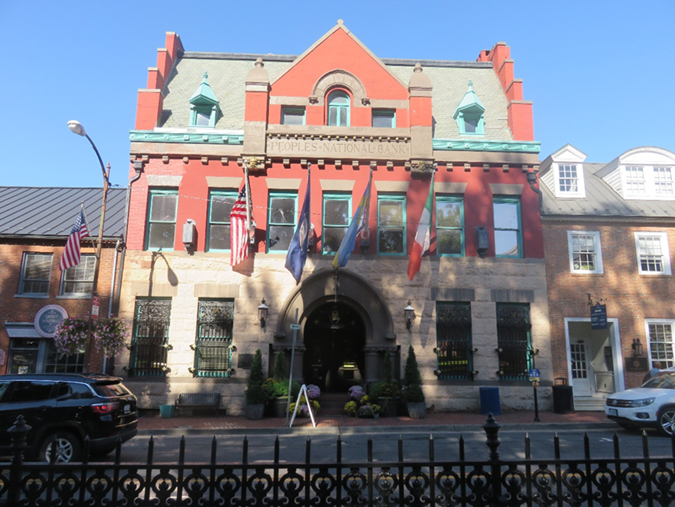

When walking through downtown Leesburg, the historic nature of King Street is apparent. Shops, boutiques, and restaurants now occupy former mercantile buildings, jewelry stores, banks, and townhomes. However, one building dominates the landscape and draws the eye with its rich Romanesque architecture: Lightfoot restaurant, formerly the Peoples National Bank of Leesburg. I have always been attracted to this building, as its architecture is unique in Leesburg. When the opportunity arose in an architectural history course I am taking for my master’s degree in Historic Preservation at Goucher College, I asked the owner, Carrie Kansu, for permission to analyze and document the building’s architecture. I am thankful she accepted, as I ended up on quite an adventure!
The former Peoples National Bank of Leesburg is certainly imposing, with its low, solid brownstone arch, Art Nouveau iron grills over the first-floor windows, and its two-and-a-half stories topped by a slate mansard roof. The interior is even more impressive, with luxurious cartouches, decorative reliefs, adorning the walls and grand fireplaces. The architectural survey firm Hartzog, Lader, and Richards in 1975 described it as the “Grandest Beaux Arts Classical space west of Washington!”[i] However, this same firm may have inadvertently created a mystery surrounding the architect of this stunning building.
In 1975, Hartzog, Lader, and Richards were hired by the town of Leesburg to conduct an architectural survey. In their report, they stated there had been two buildings at that location for the Peoples National Bank, and that the first had been designed by the prestigious architectural firm Smithmeyer & Pelz. Smithmeyer & Pelz were the famed architects who designed the Library of Congress, but in a series of unfortunate events, were fired by Congress toward the end of the project. They later sued the United States Government and won, but neither lived long enough to see any settlement money.[ii]

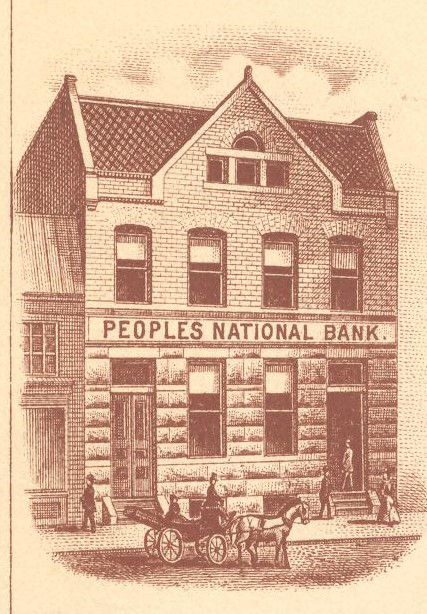
The attribution of the 1888 bank building design to Smithmeyer & Pelz has stood since 1975. However, after digging through the archives at the Thomas Balch Library, the Library of Virginia, and the Library of Congress, where the firm’s papers are held, and a variety of digital newspaper and archival sources, I found no evidence that the firm ever worked on the 1888 building. Instead, I discovered that while Pelz clearly designed the building that stands today, the architect of the original Peoples National Bank building is a mystery.
HISTORY

In the 1880s, Leesburg experienced a period of economic prosperity. The Leesburg Hotel, a combined Opera House and Town Hall, and jail were all built during this period. A correspondent for the Richmond Times reported in February 1887 that the town of Leesburg was “on the boom,” with the construction of the new Opera House/Town Hall costing $15,000 and the new hotel amounting to $25,000.[iii] The correspondent argued that the reason so many were investing in these projects was that Leesburg, because it was close to Washington, D.C., was “a desirable place as a summer residence.”[iv] The construction of the new hotel would be of business interest to the Peoples National Bank, as Elijah V. White, a future member of the bank’s board of directors and later bank president, would own the establishment.
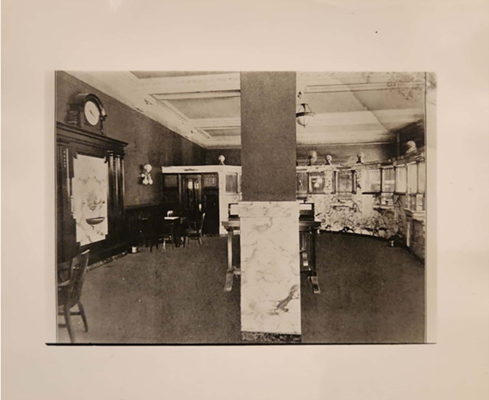
The earliest mention in newspapers of the construction of a new bank in Leesburg appeared on March 29, 1888, in The Mirror, a Leesburg publication: “(A)nd last but not least, we have every assurance that the unsightly old stone structure on King Street, will, before the close of the year, be replaced by the Peoples National Bank.”[v] It’s unknown why “Peoples” was chosen for the name, but the term became popular in the mid-nineteenth century as banks sought to appeal to a broad populace and distance themselves from their “elitist” backgrounds.[vi] As Peoples often advertised to farmers in Loudoun and other agrarian areas, they may have felt the name would appeal to their target clientele. On April 3, 1888, it was announced that Peoples National Bank of Leesburg would commence business as soon as the building was completed. Joseph D. Baker was elected President with Hugh Ashby Thompson as Cashier. The board of directors included the following prominent local citizens: Joseph D. Baker, Elijah V. White, R. H. Tebbs, H. DeButts Norris, J. W. Foster, C. W. Littlejohn, J. L. McIntosh, Dr. C. S. Carter, John Arnold, and J. B. McCabe.[vii]
MYSTERY
As previously noted, I found no evidence that Smithmeyer & Pelz designed the 1888 building, and it is unclear where Hartzog, Lader, and Richards obtained their information. If Smithmeyer & Pelz were not the architects, then who or what firm was?
The Norris Brothers, a construction and architectural firm led by brothers Joseph L. and Samuel W. Norris, is one possibility. The firm was identified in an Alexandria newspaper as the project’s builders.[viii] In fact, on June 30, 1888, an article in the Alexandria Gazette named the Norris Brothers as the builders for the Town Hall, the Opera House and the Leesburg Hotel. In the 1840s, John Norris, Joseph and Samuel’s father, had opened the Norris Planing Mill on S. King Street. John helped build Confederate forts around the town during the Civil War. After the War, Norris Planing Mill continued operations, and John also operated a construction firm called Norris & Sons.[ix] By the 1880s, Joseph and Samuel were running the business, now known as the Norris Brothers. It is possible that their brother, Lemuel Norris, designed the initial bank building. He was an architect in Washington, D.C., and worked on projects in Leesburg, including the jail, which was constructed at the same time as the bank.[x]

Another potential suspect is Harvey L. Page. According to the Leesburg Town Council minutes, Page was selected in 1887? to design the new Town Hall and Opera House, with the Norris Brothers serving as the construction company.[xi] Joseph Norris was the Mayor of Leesburg, perhaps one reason the firm was able to win so many building contracts. He worked with Page to build the Town Hall and Opera House in a Romanesque style. Page also built townhouses in Washington, D.C., in the Romanesque Revival style, featuring ashlar stone on the first story, brick on the second story, and a slate roof, similar to the 1888 bank building.[xii]

One final possible architect is Charles H. Read. Read practiced architecture in Washington, D.C., and Joseph Norris, on August 10, 1886 indicated Read had been hired to design the Town Hall and Opera House, according to Town Council minutes.[xiii] At some point, Read or Norris dissolved the contract. Read went on to design the Planters National Bank in Richmond in 1893. This building bears a striking resemblance to the 1905-06 Peoples National Bank building, but less so to the original 1888 structure.

Despite this conjecture and circumstantial evidence, no documentation exists that definitively proves the architect’s identity. What we do know is that between 1905 and 1906, the Peoples National Bank building underwent a massive remodel and renovation by the Norris Brothers, designed by Pelz. In 1904, the second bank president, Elijah V. White, began plans to remodel the building. On December 14, 1904, the Richmond News Leader announced that White had asked Pelz to submit plans for the building.[xiv] A conceptual sketch that Pelz submitted in January 1905 added an expansion to the north and featured a more Romanesque Revival style, including a stone turret and steep mansard roof.[xv] The final design dropped these elements, resulting in a more balanced and symmetrical façade. However, it did retain other elements, such as the arched entryway, the corbels and the overall Romanesque Revival appearance. At some point, the roof was scaled down to half a story, and the turret was lost. The final architectural plans cannot be found.
AFTERWARD

On May 23, 1906, as the bank renovation neared completion, Elijah B. White, son of Elijah V. White and First Vice President of the bank, sent a letter of recommendation for Pelz to M. E. Dall of Frederick, Maryland, for a Trust Company building there. In the letter, he wrote, “(W)e are just completing our new building which (Pelz) planned for us & by all who have seen it including tracelling(sic) men say it is the prettiest bank building in all of Va. & all say there is nothing in Washington more attractive although there are many there cofar more expensive. . . . It is a gem.”[xvi]
[i] Hartzog, Lader, and Richards, “13 North King Street, Architectural - Historic Inventory Card”.
[ii] John Y Cole, “Smithmeyer & Pelz: Embattled Architects of the Library of Congress,” The Quarterly Journal of the Library of Congress 29, no. 4 (1972): 282–307, https://doi.org/10.2307/29781521 .
[iii] “New Enterprises-Resignation,” Richmond Dispatch, February 24, 1887, https://www.newspapers.com/article/richmond-dispatch-new-enterprises-resign/181216718/.
[iv] Ibid.
[v] “Local News,” The Mirror, March 29, 1888.
[vi] Charles Belfoure, Monuments to Money: The Architecture of American Banks (Jefferson, North Carolina: McFarland & Company, Inc, 2005).
[vii] “New National Bank-Hotel and Improvement Company-Creameries,” Richmond Dispatch, April 3, 1888, https://www.virginiachronicle.com/?a=d&d=RD18880403&dliv=userclipping&cliparea=1.4%2C220%2C5655%2C849%2C2432&factor=6&e=--1886---1890--en-20--1-byDA-txt-txIN-Peoples+National+Bank+Leesburg+Virginia--------.
[viii] “Letter from Loudoun,” Alexandria Gazette, June 30, 1888, https://www.newspapers.com/article/alexandria-gazette-letter-from-loudoun/181593913/.
[ix] Lynda Kemp, The Norris Family, a Tradition of Building in Leesburg for Nearly One Hundred Years, 1986.
[x] “Virginia News,” Newspapers.com (Alexandria Gazette, December 31, 1887), https://www.newspapers.com/article/alexandria-gazette-virginia-news/183393917/.
[xi] “Leesburg Town Council Minutes Book 2” (Leesburg, Virginia: Town of Leesburg, April 29, 1887).
[xii] Harvey Page and J Smithmeyer, “DC Architects Directory,” Architect Bios P through S (Washington, D.C.: DC Office of Planning, n.d.), https://planning.dc.gov/sites/default/files/dc/sites/op/publication/attachments/Architects%20Bios%20P%20and%20S.pdf.
[xiii] “Leesburg Town Council Minutes Book 2” (Leesburg, Virginia: Town of Leesburg, August 10, 1886).
[xiv] “Remodeling Leesburg Bank,” News Leader, December 14, 1904, https://www.virginiachronicle.com/?a=d&d=NEL19051214&dliv=userclipping&cliparea=1.5%2C65%2C4945%2C780%2C371&factor=3&e=--1905---1905--en-20--1--txt-txIN-%22Peoples+national+bank%22+leesburg--------.
[xv] Paul J. Pelz, 1888 Peoples National Bank Interior, January 1905, Carrie Kansu Lightfoot Archival Material.
[xvi] Library of Congress, Copy of Letter from E. B. White to M. E. Dall, May 23, 1906, Paul J. Pelz Papers, Box 1, General, 1890-1917, Undated, May 23, 1906by.
[xvii] Interview with Carrie Kansu, owner of Lightfoot restaurant, by Elizabeth Welch, September 27, 2025.


A truly captivating structure! Historic bank buildings like this one hold not only architectural value but also preserve a piece of the city's history. It is fascinating to uncover the stories hidden behind the facade of a seemingly familiar building. slope
Your perspective on this topic is both unique and enlightening. I admire your ability to convey such detailed information in an accessible way. choicer voicer game
What I enjoyed about Drive Mad online is that the controls are easy to pick up, while the later obstacles require much better timing.